September 23, 2025
Wang Zongyue’s Treatise on Tai Chi Chuan: The “Bible” of Tai Chi — How 300-Year-Old Wisdom Illuminates Modern Health
Wang Zongyue’s Treatise on Tai Chi Chuan: The “Bible” of Tai Chi — How 300-Year-Old Wisdom Illuminates Modern Health
In today’s fast-paced urban life, prolonged sitting leads to back pain, poor balance, and weakened immunity—these “silent killers” are quietly eroding people’s health. Many search for fitness solutions, only to find that high-intensity workouts often trade injury for appearance. In contrast, the low-impact practice of Tai Chi offers lasting transformation.
Today, we begin with the pinnacle of Tai Chi theory—the Treatise on Tai Chi Chuan by Wang Zongyue of the Qing Dynasty—exploring its history, its revered status, and the real physical benefits it brings to practitioners. By the end, you’ll understand why this short classical text, just a few hundred words long, is honored across all Tai Chi schools and has become a “hidden health technology” for restoring vitality.
The History of the Treatise: From a Salt Shop Manuscript to the Origin of Tai Chi’s Name
The Treatise on Tai Chi Chuan first appeared during the Qianlong era of the Qing Dynasty. It was discovered by Wu Yuxiang (1812–1880) in a salt shop in Yongnian, Hebei, and later transcribed and circulated by his nephew Li Yishe.
Little is known about Wang Zongyue himself (he was still alive in 1795), but tradition holds that he synthesized earlier knowledge and was the first to systematically apply I Ching philosophy and Zhou Dunyi’s concept of “Taiji” to martial theory—formally introducing the name “Tai Chi Chuan.”
Historical accounts suggest that Wang may have passed his teachings to Jiang Fa, who then transmitted them to Chen Changxing of Chen Village and Xing Xihuai of Zhaobao Town, influencing major lineages such as Chen and Yang styles. While legends attribute Tai Chi’s creation to Zhang Sanfeng, Wang Zongyue’s true contribution lies in integrating philosophical principles—yin and yang, movement and stillness, emptiness and solidity—into practical martial application, forming a complete theoretical system.
This work is not abstract philosophy but a practical guide. It begins with:
“Taiji is born of Wuji; it is the mechanism of movement and stillness, the mother of yin and yang.”
This establishes the core of Tai Chi: overcoming hardness with softness and yielding to others. Whether in the explosive Chen style or the flowing Yang style, all schools are rooted in this principle—demonstrating its universal relevance.
Its Status: The “Supreme Classic” of Tai Chi
Within the Tai Chi world, the Treatise is regarded as a “sacred text” or “supreme classic.” Despite the many schools (Chen, Yang, Wu, Sun, and others), often divided by lineage differences, all practitioners unanimously revere this text.
Why such prestige?
Because it systematically explains:
· The principles of movement and application
· The techniques of practice
· The stages of mastery
From the efficiency principle of “four ounces deflecting a thousand pounds,” to the progressive realization of “understanding energy” (dong jin), to the harmony of yin and yang—it teaches not only how to practice, but why.
It elevates practitioners from physical form to deeper awareness, leading to the state of:
“Others do not know me, but I know them.”
Masters such as Yang Luchan and Wu Yuxiang built upon this foundation. Even today, researchers worldwide regard it as the theoretical peak of Tai Chi. It has transformed Tai Chi from a martial art into a holistic system of health, philosophy, and even modern rehabilitation science.
From Theory to Practice: The Body’s “Understanding Energy” Code
The Treatise is essentially a manual of benefits. Its principles map directly onto modern human physiology:
· Yin-Yang Balance
Training transitions between empty and full enhances body awareness and dynamic stability.
· “Four Ounces Deflect a Thousand Pounds”
Avoid brute force; cultivate functional flexibility and endurance.
· Sinking Qi to the Dantian & Upright Alignment
Improves posture, strengthens the core, and deepens breathing.
· From Familiarity to Understanding Energy
With practice, the body “upgrades” naturally, achieving effortless coordination and vitality.
These principles make Tai Chi a low-impact, high-return exercise—far beyond simple stretching or jogging.
Proven Benefits of Tai Chi: A Scientifically Supported “All-in-One Wellness Practice”
Guided by the Treatise, Tai Chi’s benefits have been repeatedly validated by research worldwide. Practicing just 10–20 minutes daily for 8–12 weeks can lead to noticeable improvements:
1. Balance & Fall Prevention
Enhances inner ear function and proprioception, significantly reducing fall risk—especially for older adults.
2. Strength, Flexibility & Joint Health
Improves muscle elasticity and joint mobility. Within 8–16 weeks, stiffness decreases, and chronic back or knee pain often improves.
3. Posture & Core Stability
Promotes spinal alignment and strengthens deep core muscles. Sedentary individuals experience better breathing and sustained energy.
4. Cardiovascular, Immune & Overall Vitality
Deep breathing enhances heart health, lowers blood pressure, and reduces inflammation. Studies show improved immunity, sleep, and mood—along with benefits for managing conditions like hypertension and diabetes.
5. Mind-Body Integration
The “understanding energy” stage improves focus and reduces stress—functioning like a form of moving meditation.
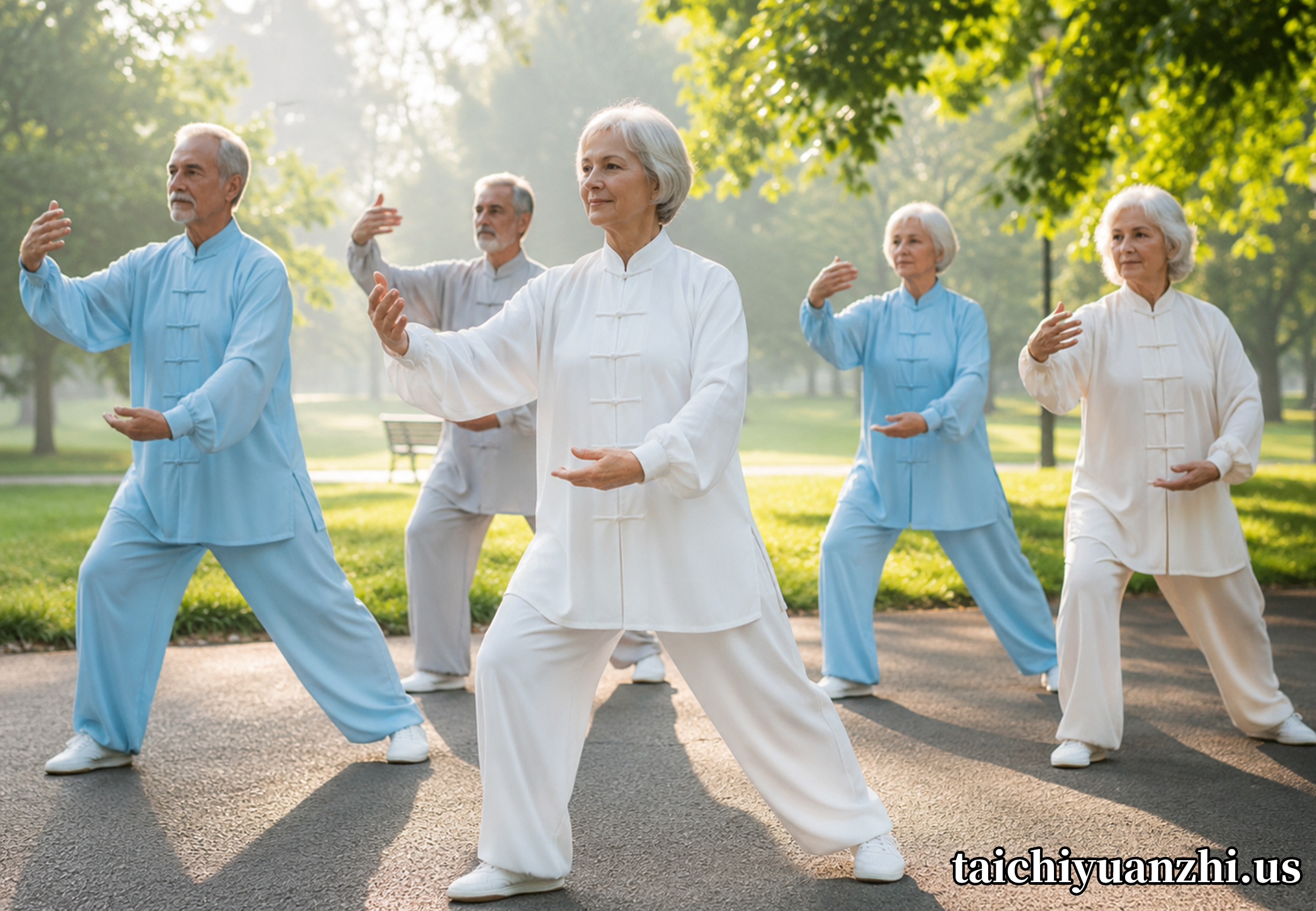
These benefits apply to all ages:
· Young people build efficient, sustainable fitness
· Middle-aged individuals reduce sub-health symptoms
· Older adults regain independence
Unlike high-intensity workouts that risk injury, Tai Chi offers a sustainable path—nourishing strength through softness.
Begin Your Transformation Today
Wang Zongyue’s 300-year-old wisdom remains one of the greatest gifts for modern life. It reminds us that true health doesn’t come from force, but from intelligent, harmonious movement.
To begin:
· Start with standing meditation (zhan zhuang): relax the shoulders, sink the breath, gently shift weight
· Or join a structured course to gradually develop “understanding energy”
Your body deserves this timeless care.
Practicing Tai Chi isn’t adding a burden—it’s opening the door to 365 days of comfort, vitality, and balance.