September 23, 2025
The Modern Echo of Classical Wisdom: Begin Your Journey of Mind-Body Transformation with Wang Zongyue's Treatise on Tai Chi
01 The Foundational Text: Why is the Treatise on Tai Chi Hailed as the "Bible of Tai Chi"?
Among the vast canon of martial arts literature, Wang Zongyue's Treatise on Tai Chi holds an exceptional status. Written during the Qing Dynasty, though concise, it shines like the North Star, providing the core theoretical and technical direction for all subsequent Tai Chi schools.
This treatise was the first to systematically integrate Taoist Yin-Yang philosophy, traditional medical practices of daoyin (guiding and stretching) and breath regulation (tuna), and martial arts combat techniques, elevating them into a unique mind-body art. It defines the essence of Tai Chi: "What is Tai Chi? It is born from Wuji (the limitless) and is the mother of Yin and Yang," emphasizing the principle of movement: "In motion, it divides; in stillness, it unites."
For practitioners, it is not merely a technical manual but the essential guide to mental approach. Whether you practice Chen, Yang, Wu, Wu (a different character), or Sun style, their core training principles do not deviate from the framework of the Treatise. In essence, to understand it is to hold the first key to unlocking the treasure trove of Tai Chi wisdom.
02 Core Principles: Timeless Mind-Body Laws in Ancient Philosophy
The charm of the Treatise on Tai Chi lies in its translation of profound philosophy into practical body language. Its three core principles remain directly relevant to the physical and mental health of modern people.
"Relaxation and Sinking" (Song Chen) and "Centered, Upright, Comfortable, and at Ease" (Zhong Zheng An Shu): The treatise emphasizes that "the body must be centered, upright, comfortable, and at ease, supporting all eight directions." This is not merely a postural requirement but a metaphor for a way of life—maintaining mental "centeredness" and inner "ease" amidst life's pressures.
The common modern ailments of neck, shoulder, and back pain, along with postural imbalance, often stem from chronically tense muscles and misaligned skeletal structures. The practice of "relaxation and sinking" in Tai Chi teaches us precisely how to release unnecessary tension and rediscover the body's natural, efficient alignment and balance.
"Use Intention, Not Force" (Yong Yi Bu Yong Li): This is one of the most revolutionary principles. It advocates guiding movement and the flow of energy (qi) with consciousness, rather than relying on localized muscular brute force.
From a neuroscience perspective, this is equivalent to optimizing the brain's command pattern over the body, enhancing neuromuscular coordination efficiency. For modern people who are mentally overextended yet disconnected from bodily sensations, this practice rebuilds the crucial "mind-body connection."
"Seeking Stillness in Motion, Overcoming Hardness with Softness": The treatise describes "within stillness, stirring movement, yet movement is as stillness," seeking inner peace within continuous, flowing motion. Simultaneously, the principle of "softening"—"let a great force come to strike me; I guide it with four ounces to deflect a thousand pounds"—epitomizes this.
This is not only a sophisticated combat strategy but also an exceptional philosophy for stress response and emotional management. It teaches us how to maintain our own stability and harmony when facing external impacts and pressure, through transformation and guidance rather than rigid resistance.
03 Mind-Body Transformation: A Science-Backed List of Health Benefits
When you put the principles of the Treatise on Tai Chi into practice, the benefits are comprehensive. A wealth of modern research in sports medicine and psychology continues to provide empirical support for this classical wisdom.
Gifts for the Body: Optimizing Structure and Function
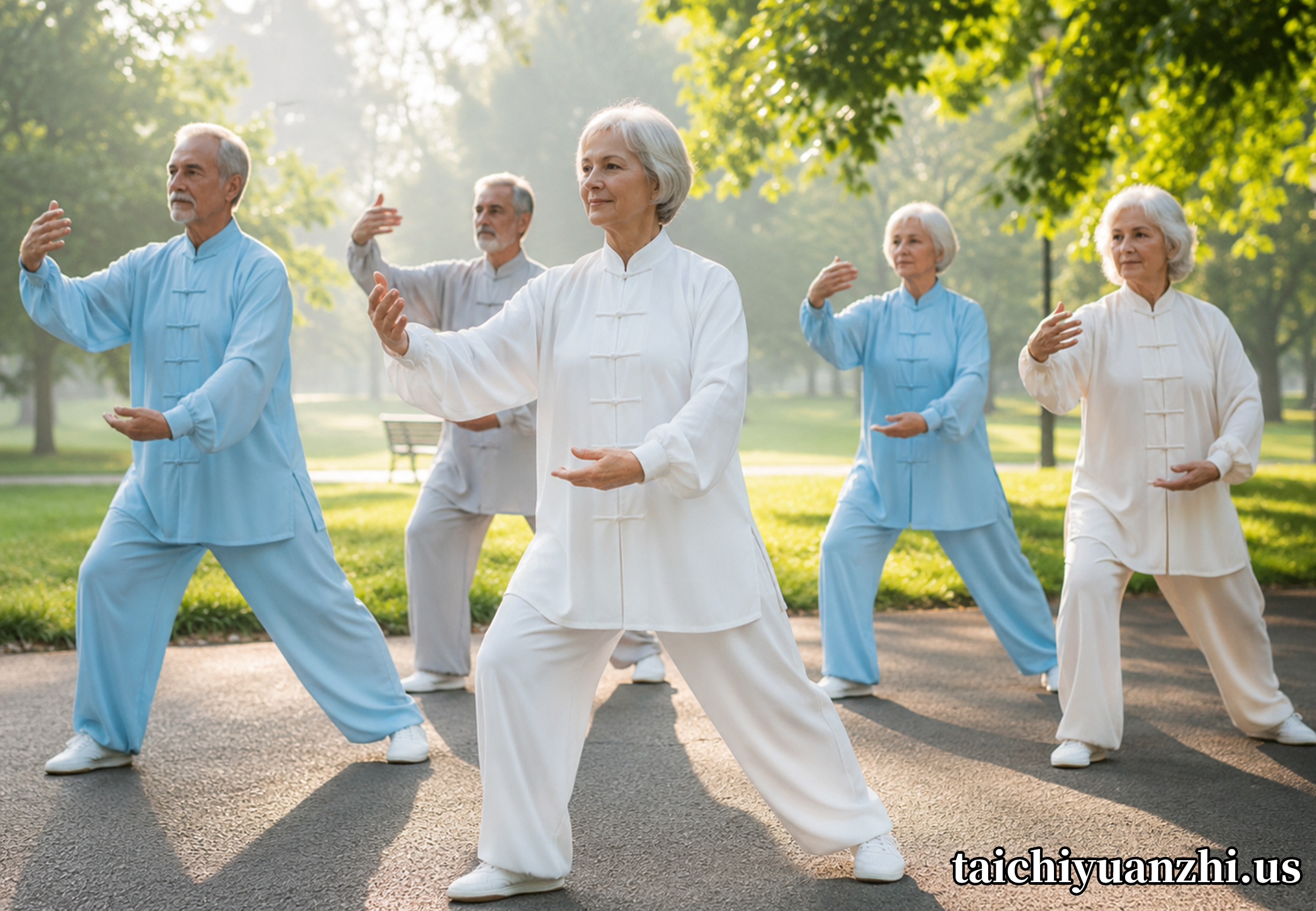
· Rebuilding Balance, Reducing Fall Risk: Often called "meditation in motion," Tai Chi offers unparalleled training for the vestibular system and proprioception. Studies confirm that regular practice can significantly improve dynamic balance, proving especially effective in preventing falls among older adults.
· Alleviating Chronic Pain, Particularly in the Back and Joints: Through the spiral "linked through every joint" movement and the core requirement of "relaxing the waist and sinking the hips," Tai Chi gently realigns spinal forces, releases joint pressure, and strengthens deep stabilizing muscles, addressing the root causes of musculoskeletal pain.
· Optimizing Cardiovascular and Respiratory Systems: The combination of deep, long, fine, and even abdominal breathing with gentle, sustained movement can moderately enhance cardiopulmonary function, regulate blood pressure, and effectively activate the parasympathetic nervous system, inducing a deep relaxation response.
Nourishment for the Mind: Cultivating Calm Amidst Movement
· A Natural Stress Dissolver: By focusing on slow, continuous movements and breath, the mind is drawn away from scattered thoughts. This state of "dynamic meditation" can effectively lower levels of the stress hormone cortisol and improve emotional stability.
· Enhancing Focus and Cognitive Function: Memorizing and executing complex movement sequences requires a high degree of mind-body unity and sustained concentration. This serves as an excellent workout for the brain, helping to improve working memory and cognitive flexibility.
· Cultivating Holistic Awareness: Practice demands that "when one part moves, every part moves," perceiving the body as an interconnected whole. This enhanced awareness subtly influences daily life, allowing you to more keenly perceive your own state and external changes, leading to more harmonious responses.
04 The Path to Begin: How to Integrate Classical Wisdom into Daily Life?
You might wonder if the threshold is too high for such a profound classic and art. In fact, the greatness of Tai Chi lies precisely in its universality. Regardless of age or fitness level, you can start from a point suitable for you.
Start by Building Correct Understanding: Before seeking a teacher or class, consider reading a modern translation of the Treatise on Tai Chi or related interpretive articles. Establish a correct direction in your mind—prioritizing "intention over force," "seeking relaxation over rigidity." This can help you avoid the pitfall of pursuing external form over internal substance.
Seek a 'Clarifying Teacher,' Not Just a 'Famous One': A good foundational teacher should clearly explain the principles behind the movements and emphasize internal sensation over external precision. Observe whether the teacher can integrate the Treatise's philosophy into their instruction.
Begin with 'Standing Postures' (Zhan Zhuang) and Foundational Exercises: Don't rush to learn complex forms (taolu). Start with static practices like Wuji Stance or Hunyuan Stance to experience "centered, upright, comfortable, and at ease" and "relaxation and sinking." Practice single movements like "Cloud Hands" or "Parting the Wild Horse's Mane" to feel "linked through every joint." These are the foundational stones that carry the essence of Tai Chi.
Maintain Patience, Focus on the Process: Let go of the desire to "learn quickly." Tai Chi is an inward journey of exploration. Its core benefits come from the daily practice of noticing and adjusting the body and breath, bit by bit. As the treatise says: "From familiarity with the postures, one gradually comprehends dong jin (understanding energy); from comprehending dong jin, one can approach the level of spiritual illumination."
When you slowly begin your form in the morning light, feeling the breath sink and a slight swelling sensation in your fingertips, you might connect with the intention of that predecessor from three centuries ago who wrote, "a feather cannot be added, a fly cannot land." What he elucidated was not merely the mental method of a martial art but a life art of seeking internal and external harmony in a turbulent world.
Today, this wisdom is no longer confined to ancient texts. It is being transformed, through your body and breath, into tangible calm, strength, and health. The starting point of the journey lies within your next wholehearted, mindful breath.